Using AI to kickstart message model development

· 3 min read
Jesper Kuiper (TNO)
Technical expert & Developer

At Semantic Treehouse, we're all about shaping ideas about data and its meaning into explicit and explainable message models. These message models are the bedrock on which to build powerful and unambiguous software ecosystems, like the European Union's envisioned Digital Product Passport system!

In a previous blogpost by my colleague Wouter (ENDORSE '25, BOMOS), he talked about our vision of using Generative AI for semantic interoperability. The core idea he conveyed there, and which I will also highlight here again, is that semantic interoperability at its core is not a technical problem. It's a problem of – a lack of – human coordination. Keeping this in mind, we have asked ourselves the question: How can AI help advance or accelerate the systematic BOMOS approach to standardization? In this blog post, I'm happy to show to you the first part of our STH Co-pilot roadmap: AI-assisted message model creation!


Mappings as first-class citizens

· 8 min read
Wouter van den Berg (TNO)
Expert semantic interoperability & Scrum master

Over the years, mappings have been a recurring topic in our conversations with our partners and communities. For example, our earliest issues and feature requests with the word "mapping" date back to 2017/2018. And our partners consistently identified support for mappings as a priority feature in all of our open roadmapping sessions.

That's why I'm very happy to share that we have reached a new milestone this month: mappings are now first-class citizens in Semantic Treehouse.

ENDORSE 2025 | GenAI for interoperability

· 3 min read
Wouter van den Berg (TNO)
Expert semantic interoperability & Scrum master

What drives our work is the idea that semantic interoperability is not fundamentally a technical problem, but a commons governance problem. As we’ve mentioned before: 'Systems not talking actually represent people not talking.' Keeping that in mind, we are asking the question: how can Generative AI help?

That was the subject I explored in my recent presentation, "Practical Experiences with BOMOS, Semantic Treehouse, and GenAI," at the ENDORSE 2025 conference in Brussels. For those who couldn't attend, I'm happy to share the full recording of the session.

Semantic Treehouse roadmapping sessie 2025

· 6 min read
Wouter van den Berg (TNO)
Expert semantic interoperability & Scrum master

Op 5 juni organiseerde TNO een Semantic Treehouse roadmapping sessie in Utrecht. Aan alle deelnemers onze hartelijke dank voor jullie aanwezigheid en waardevolle inbreng!

Terugblik​

Dit was inmiddels de derde keer dat we een dergelijke sessie organiseerden. In 2022 hielden we onze eerste gebruikersmiddag, en deze keer kwamen we weer samen bij YouMeet in Utrecht voor een middag vol inspiratie, uitwisseling en gezamenlijke roadmapping.

Het doel van deze sessie was opnieuw tweeledig. TNO wilde samen met standaardisatie-experts uit verschillende sectoren:

  1. Kennis en ervaringen delen over trends en ontwikkelingen op het gebied van digitalisering en interoperabiliteit
  2. Samen de toekomstige ontwikkelroadmap van Semantic Treehouse vormgeven en prioriteren

Semantic Treehouse and BOMOS

· 10 min read
Wouter van den Berg (TNO)
Expert semantic interoperability & Scrum master

In a discussion about the possible role of AI to solve problems of interoperability, a colleague recently observed: "Semantic specifications are just expressions of human coordination." (Perhaps you can guess his stance on the potential of AI.) These words reminded me of a former client who I think once captured the same principle from a different angle by saying: "Systems not talking represents people not talking." These observations point at what to me is the core of standardization work: that the real challenge with interoperability is the human coordination it requires. Sometimes our conversations about interoperability focus a little too much on the technology, while it is the coordination that make all these technical specifications valuable.

For many organizations in the Dutch standardization community, the BOMOS (Management and Development Model for Open Standards) provides the framework for this coordination. BOMOS guides the creation and maintenance of high-quality, open standards through structured processes covering strategy, tactics, operations, implementation support, and communication.

This post clarifies how Semantic Treehouse serves as a practical, digital environment equipped with features specifically designed to support these BOMOS activities. Our platform was born from the need to execute these very processes more effectively, and this connection remains core to our identity, even as we serve broader roles like being a Vocabulary Hub in European Data Spaces.

From legislation to digital product passports

· 6 min read
Jelte Bootsma (TNO)
Expert semantic interoperability
Jesper Kuiper (TNO)
Technical expert & Developer

The call for a more transparent and sustainable economy is loud and clear. We want to know where products come from, what they are made of, and how we can responsibly reuse them. Digital Product Passports (DPPs) are essential for this: they give each product its own passport detailing its lifecycle. The European Union is strongly committed to DPPs to encourage more sustainable choices. However, practical implementation is challenging and complex. Products travel the globe, through supply chains with numerous actors and diverse IT systems. How do we ensure that the data in a DPP in Spain is as usable and understandable as it is in the Netherlands or Vietnam? We need a "common language", a standard that ensures everyone interprets the same information in the same way. Without such a language, a DPP is like a product instruction manual in a language you don't speak. You see the words, but the instructions are lost on you.

The need for practical implementations of DPPs is precisely what we are addressing within our work, and we are addressing it from multiple perspectives. For instance, we have established a DPP Semantic Treehouse environment – https://dpp.vocabulary-hub.eu/ – which serves as the hub where the 'common language' for all product types can be hosted, managed, and shared. Beyond this environment, we are actively engaged in various projects, developing features to simplify the process of creating DPPs. But how does that work? Let's dive into it!

New feature: the JSON Validator!

· 2 min read
Jelte Bootsma (TNO)
Expert semantic interoperability
Michiel Stornebrink (TNO)
Product owner Semantic Treehouse

JSON Validator​

We’re excited to share that our new JSON validator is ready to use! This new validator helps you validate your JSON messages against the agreed schemas in your ecosystem.

With more and more ecosystems relying on JSON to share data, it became essential for us to have a JSON validator in addition to our XML validator. So, we teamed up with a group of students from the University of Groningen, and together we created a first version of this validator.

SEMANTICS-2024 | Semantics in data spaces

· 2 min read
Jelte Bootsma (TNO)
Expert semantic interoperability
Linda Oosterheert (TNO)
Expert semantic interoperability & Project manager

About our workshop​

From September 17-19, 2024, we attended the SEMANTICS-2024 conference in Amsterdam, where we delivered a half-day tutorial about semantics in data spaces.

The workshop provided a practical perspective on the role of semantics in data spaces, based on the current challenges we face in practice. We talked about:

  • Data spaces and the role of a vocabulary hub,
  • How to established semantic interoperability in a data sharing community setting,
  • How the bridge the gap between the two paradigms for interoperability: Linked Data based interoperability and (EDI) message based interoperability.

IDSA Tech Talk | Semantic Interoperability in Data spaces

· One min read
Michiel Stornebrink (TNO)
Product owner Semantic Treehouse

About the talk​

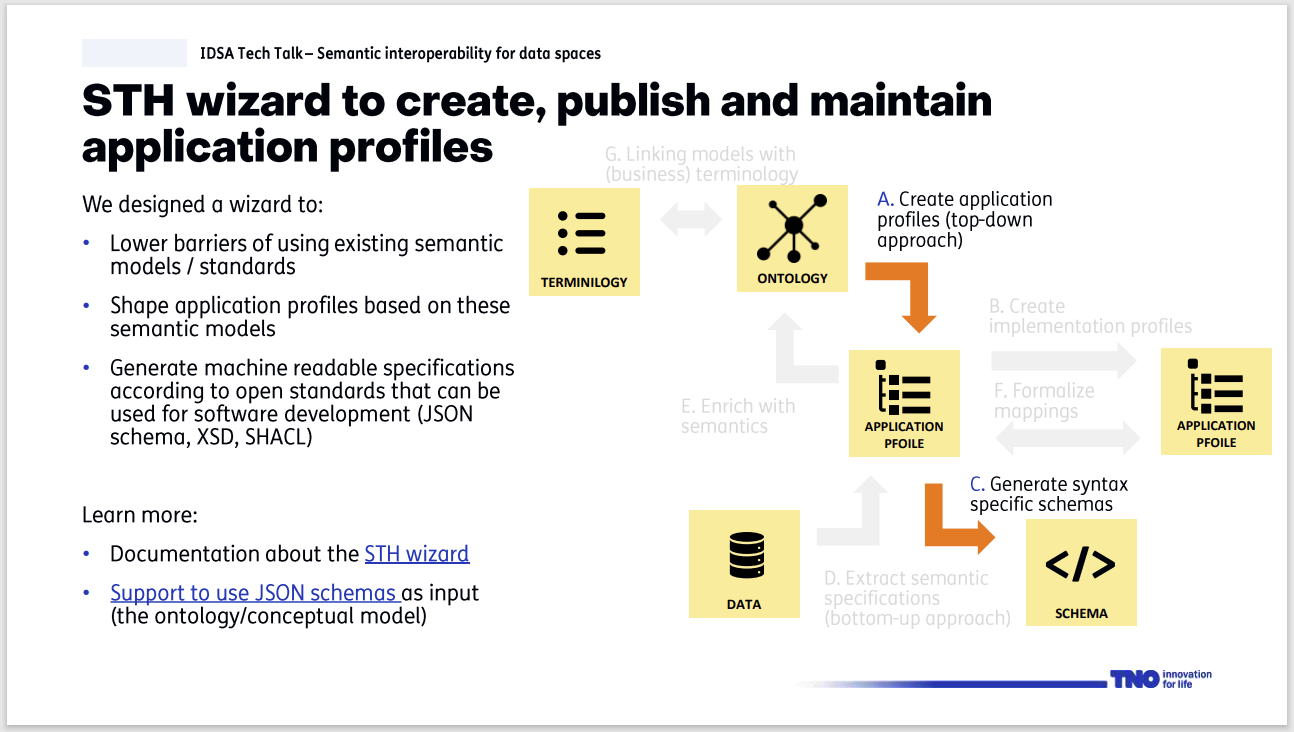
In this second IDSA Tech Talk on semantic interoperability in data spaces we shared our view and lessons learned on the role of Application profiles in specifying semantics for data spaces. Thank you IDSA for the opportunity to share and learn from the data spaces community.

Application profiles

View online​

Read more​